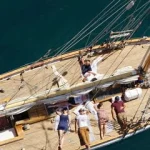
Having proudly crossed seas and oceans, she is now in the hands of a couple with a passion for classic boats, who have brought this little gem back to life.
ELEANOR MARY, A PILOT CUTTER?
Pilot cutters are the forerunners of today's pilot boats, which carry harbour pilots out to merchant ships as they approach port.
Before engines became the norm, pilot boats were sailing vessels. Pilot cutters combine the two qualities their work demanded: seaworthiness and speed. Their solid, stable hulls and clean lines make them instantly recognisable, but it is their wildly oversized rig that has won them such a following.
Pilot cutters were a well-established type by the 18th century and were refined over the years. The most celebrated are the Bristol Channel pilot cutters of the late 19th century.
Every pilot cutter enthusiast knows the names Cornubia, Hesper and Marguerite T.
AN AUDACIOUS ONE-OFF REPLICA
The year is 1996. David Darbyshire, an Englishman with a passion for pilot cutters, decides to commission a replica of the most famous of them all: the Marguerite T (1893).
The ambitious project is entrusted to the Canadian yard Covey Island Boatworks, which has already built several boats of this kind.
From the outset, David brings in the finest designers, Nigel Irens and Ed Burnett: no expense is spared on quality, and everything must be perfect. Nigel Irens is known for designing Ellen MacArthur's trimaran, on which she broke the solo round-the-world record in 2005.
Ed Burnett is regarded as a genius of naval architecture, a reputation crowned in 2012 when he was entrusted with the vessel for Elizabeth II's Diamond Jubilee. The ultimate honour, if ever there was one.
Construction of Eleanor Mary begins in 1998.
ELEANOR MARY'S CREDENTIALS
As if building a one-off vessel at a yard across the Atlantic were not ambitious enough, David insists that the boat be built to the British “Category 0” standard, so that she can be operated anywhere in the world.
On top of this came the requirement to meet the latest European Union standards: three watertight bulkheads, two highly detailed stability studies, extra precautions in the pumping systems, a strip-planked hull…
The last British maritime inspector to survey Eleanor Mary remarked that this accumulation of construction standards had made her one of the sturdiest boats around.
DESTINATION: TALL SHIPS RACE 2000
David Darbyshire set himself the goal of finishing Eleanor Mary in time to take part in the transatlantic Tall Ships Race of 2000.
After a first Atlantic crossing to bring her home to England, Eleanor Mary needs some fine-tuning. Although the rig is only two years old, David has it entirely replaced, in Oregon pine, by the best rigger in Cowes.
On the start line, David is ready to live his dream. Collecting his prize at the end of the Tall Ships Race, he admits with a smile that the hardest part of the race was keeping the young crew in check during stopovers! Mission accomplished.
TWENTY YEARS AT SEA
After the Tall Ships Race, Eleanor Mary crosses the Atlantic twice more.
She also faces some of her toughest voyages in the fickle seas of Sweden and Norway, where she weathers several storms, as well as a passage to the Azores, where David spends his holidays.
In 2008, she is sold to a couple who sail her from England to L'Estartit, in Spain, from where she crosses to Palma and Ibiza several times a year for seasonal coastal cruising, under the name Alexander T.
Maintained only superficially and sailing less and less, she gradually loses her splendour.
ELEANOR MARY BECOMES FRENCH… AND MARSEILLAISE
In 2021, the pretty pilot cutter is up for sale in Spain.
Fanny and Benoît Bouchet, already the owners of Le Don du Vent, fall in love with her.
She is sailed to Marseille under a temporary flag, before the ordeal of re-registering a British boat in France after Brexit begins. In May 2022, she finally sails under the French flag!
Benoît decides to give her back her original name: Eleanor Mary becomes a true Marseillaise.
Little sister to Le Don du Vent, she completes the range of sailing trips to discover the Calanques, departing from Marseille's Vieux-Port.